
Planning a wedding, corporate dinner, mehndi or a birthday in Pakistan can feel overwhelming. Where do you start? What should you book first? How much should you keep aside?
This step-by-step event planning checklist for Pakistan answers all of that. It covers budgeting in PKR, venue booking, vendor selection, catering, decor, guest lists, entertainment and a full month-by-month timeline — with Pakistan-specific advice throughout.
Whether you are planning your own wedding or organizing an office event, follow these steps in order and nothing important will slip through the cracks.
Key Takeaways
- Start 4–6 months early for weddings; 2–3 months is enough for smaller events like birthdays or corporate dinners.
- Set your budget first — a middle-class Pakistani wedding costs PKR 1.5M–3.5M, while a corporate event for 200 guests typically runs PKR 800,000–2M.
- Book the venue before anything else — popular marquees in Lahore, Karachi and Islamabad fill up 3–6 months ahead in wedding season (December to February).
- Always arrange a power backup — load-shedding is a real risk; a generator or UPS for marquees and outdoor events is non-negotiable.
- Add 10–15% extra to your budget for hidden costs like generator fuel, guest transport and vendor overtime.
Step 1: Set Your Budget
Everything starts with money. Decide your total budget before you visit a single venue — otherwise every decision will pull you in a different direction.
The direct answer: An event planning budget in Pakistan starts with your total number, split across venue (25–30%), catering (30–40%), decor (10–15%), photography (5–10%) and everything else. A typical middle-class wedding of 300–500 guests costs PKR 1.5M–3.5M, a premium wedding PKR 4M–8M, and a corporate event of 150–250 guests usually costs PKR 800,000–2M depending on the venue and menu.
| Event type | Typical budget range (PKR) | Guests |
|---|---|---|
| Middle-class wedding (2–3 events) | 1.5M – 3.5M | 300–500 |
| Upper-middle wedding | 4M – 7M | 400–800 |
| Luxury wedding | 8M – 15M+ | 500–1,000+ |
| Corporate dinner / conference | 800,000 – 2M | 150–250 |
| Birthday / private party | 100,000 – 500,000 | 50–150 |
Practical tips:
- Fix the guest count early. Catering is your biggest cost, charged per head. Every extra 50 guests can add PKR 150,000–250,000 to the bill.
- Keep a 10–15% emergency fund. Generator fuel, vendor overtime, last-minute guests and extra decor always come up.
- Decide who pays what. In Pakistani families, costs are often split between families or across events (mehndi by one side, walima by the other). Settle this before booking anything.

Step 2: Pick Your Date and Season
Your date decides your venue availability, your prices and even your guest comfort. In Pakistan, season matters a lot more than most people realize.
The direct answer: The peak wedding season in Pakistan runs from late October to March, with December, January and February being the busiest months. Marquees and banquet halls charge premium rates then and book out 3–6 months ahead. Avoid outdoor afternoon events from May to August because of extreme heat, and avoid late-night road travel in Punjab in December and January because of dense winter fog.
More Pakistan-specific date advice:
- Summer afternoons are a no-go. Outdoor events between May and August can hit 40°C+. If a summer date is unavoidable, plan for the evening and confirm air-cooling with your venue.
- Winter fog in Punjab is real. In December and January, fog can close the M2 motorway and delay guests travelling between cities. Keep baraat and rukhsati timings realistic.
- Religious calendar pauses. Weddings slow down during Muharram and Ramadan. Some venues offer off-season discounts in these months — worth asking about.
- Corporate events work best from February to April and September to November, when the weather is pleasant and executives are not on Eid or winter holidays.
- Check for clashes. Big cricket matches (like PSL), public holidays and exam seasons can affect attendance. A quick check saves embarrassment.
Step 3: Book Your Venue
Book the venue first — everything else (catering, decor, guest count) flows from this one decision.
The direct answer: Book your venue 3–6 months before the event for weddings and 1–2 months ahead for corporate or private events. Compare at least 3 venues, visit in person, and check parking, washrooms, bridal room, kitchen access and power backup before paying the advance. Popular wedding venues in Lahore include The Pavilion, Chenab Club Road marquees and DHA farmhouses; in Karachi, Clifton and DHA banquet halls and beachside farmhouses are popular.
What to check on every venue visit:
- Capacity vs. your guest list. A hall that fits 400 will feel empty with 150 guests and suffocating with 600.
- Power backup. Ask exactly what the backup covers — full lighting and sound, or just emergency lights? This matters most for marquees and farmhouses.
- In-house vs. outside catering. Some venues force you to use their caterer; others allow outside vendors for a fee.
- Parking and access. In DHA Karachi or Gulberg Lahore, parking space decides whether guests arrive happy or frustrated.
- Timing restrictions. Many halls in residential areas must end by 10 or 11 PM. Confirm the closing time before you plan a late-night dance floor.
- Advance payment. Most venues ask for 25–50% advance to block the date, with the balance due a week before the event. Always get a written receipt with the date, hall name and services included.
For a deeper look at real options, see our guides to the best wedding venues in Lahore and the best wedding venues in Karachi.
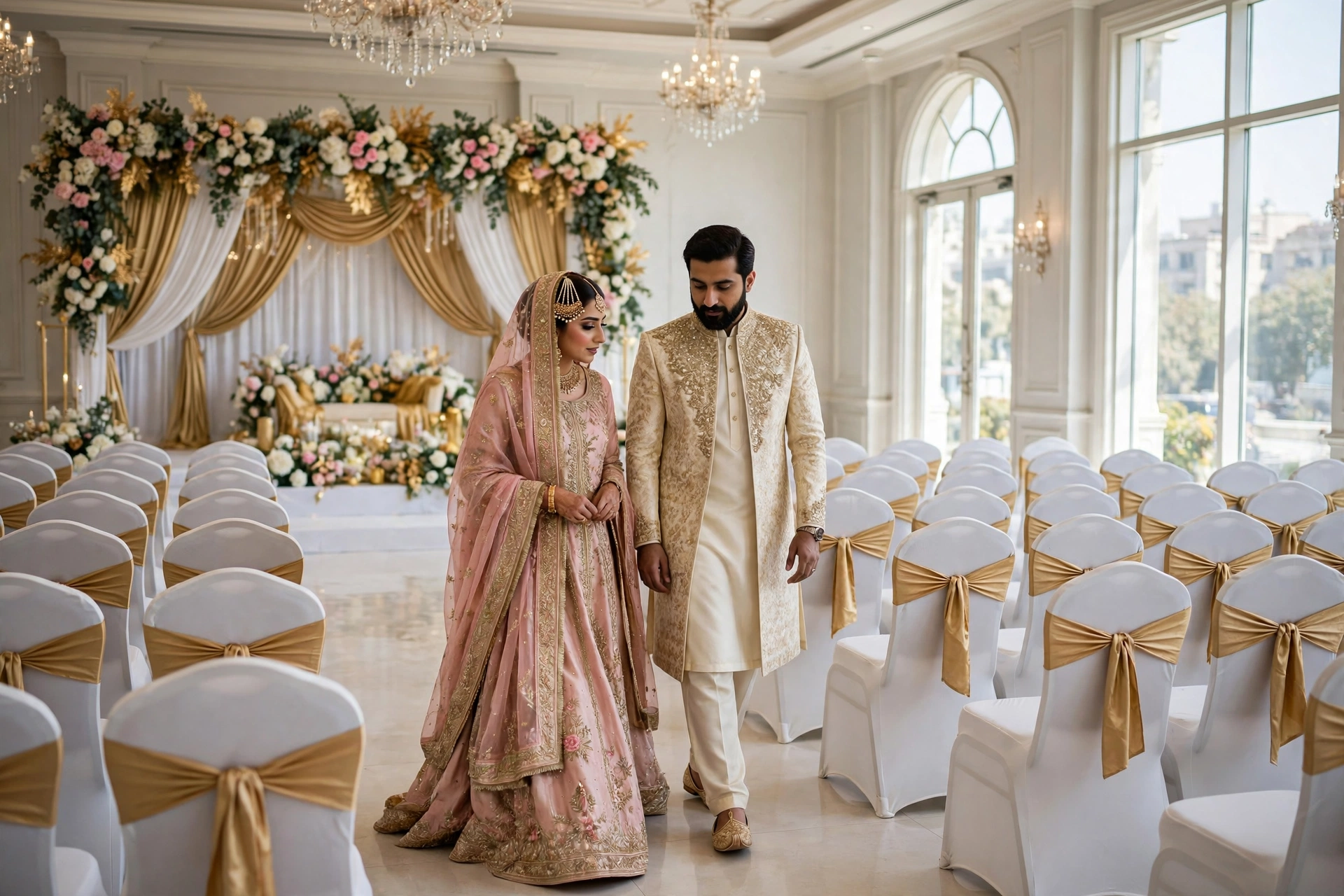
Step 4: Hire Your Vendors
Once the venue is locked, book your big three: caterer, decorator and photographer. These are the vendors that make or break an event.
The direct answer: Book your caterer, decorator and photographer 2–4 months before the event, starting with whichever is scarcest in your city. Expect to pay 30–50% advance to confirm each vendor, with the balance settled on or just before the event day. Always sign a simple written agreement covering the date, services, timings and total price.
Caterers
- Shortlist 3 caterers, attend a food tasting, and compare menus per head. Standard buffet catering in Karachi and Lahore runs PKR 3,000–5,000 per person; premium wedding menus with BBQ and live stations reach PKR 4,000–8,000 per person.
- Confirm what is included: crockery, serving staff, buffet setup, drinks and desserts. “Per head” quotes that exclude staff and setup are a classic surprise.
- Ask about their kitchen setup at the venue — especially for marquees and farmhouses where there is no built-in kitchen.
Decorators
- Decor for a standard wedding stage and hall setup costs PKR 150,000–350,000; premium floral and themed decor can go much higher.
- Share reference photos but let the decorator suggest what suits your venue. A small hall cannot carry a giant stage.
- Confirm setup and teardown timings — some venues only allow setup 4–6 hours before the event.
Photographers and Videographers
- Standard wedding photography packages cost PKR 80,000–200,000; top-tier teams charge PKR 300,000+.
- Book early — good photographers are taken for the whole December–February season.
- Clarify deliverables: number of edited photos, album, teaser video, full film, and delivery timeline (2–8 weeks is normal).
Vendor advance culture in Pakistan: paying 30–50% advance is standard and expected. Never pay 100% upfront. Keep every receipt, and confirm the final balance amount in writing a week before the event so there are no day-of arguments.
Step 5: Plan the Catering
Food is what guests remember. In Pakistan, catering decisions deserve their own step.
The direct answer: Plan catering per head, not per dish. Finalize your guest count 7–10 days before the event, order 5–10% extra food as buffer, and always do a tasting before signing. For weddings, typical menus include 2–3 main dishes, rice, BBQ, salad bar, naan, desserts and drinks; corporate events usually go for a simpler 2-dish buffet or hi-tea.
Menu planning tips:
- Match the menu to the event and time. Hi-tea suits afternoon corporate events; a full dinner buffet suits weddings and walimas.
- Count kids and staff. Caterers usually charge half rates for children — confirm this.
- Drinks and desserts add up. Kashmiri chai, fresh juices and a dessert counter can add PKR 300–500 per head.
- Dietary needs. Ask guests about allergies or dietary restrictions on the RSVP; keep at least one simple option (like daal or grilled chicken) for sensitive stomachs.
- Serving style. Buffet is standard for large Pakistani events. For VIP or corporate events, consider served courses or live cooking stations.
Step 6: Sort Out Decor and Setup
Decor sets the mood. Keep it simple, clean and matched to your venue — over-decoration in a small hall looks cluttered, not grand.
The direct answer: Finalize your decor theme and color scheme 6–8 weeks before the event, confirm the setup schedule with your venue, and do a final walkthrough the day before. Standard stage-and-hall decor costs PKR 150,000–350,000 in major cities; entryways, photo booths and table centerpieces are the extras that lift the look without doubling the cost.
- Stage design is the centrepiece for weddings — bridal stage, backdrop and floral arrangements.
- Lighting transforms a venue more cheaply than flowers. Warm fairy lights, uplighters and a good spotlight on the stage go a long way.
- Entry and welcome area — a decorated entrance and welcome drinks station set the tone from the first step.
- Seating plan for corporate events and formal dinners: VIP tables near the stage, families together, clear walkways for serving staff.
- Signage — simple boards for directions, the stage schedule and washrooms save guests from confusion.
Step 7: Invitations and Guest List
In Pakistan, the guest list is a family project. Start early — it always takes longer than expected.
The direct answer: Send or distribute invitations 3–4 weeks before the event for local guests and 6–8 weeks ahead for out-of-city family. Finalize the guest list 7–10 days before and share the final headcount with your caterer. For weddings, plan separate counts for mehndi (usually 100–200 guests), baraat (300–600) and walima (400–800+), since each event has a different scale.
Practical advice:
- Digital + printed. WhatsApp invitations are now normal and save money, but elders still appreciate a printed card. Do both if the budget allows.
- Track RSVPs. A simple spreadsheet or WhatsApp group per family side keeps the count honest.
- Baraat timing realities. Baraats in Pakistan rarely leave on time. Plan the baraat departure 1–2 hours after the time printed on the card, and tell the venue your realistic arrival time — not the optimistic one.
- Guest transport. For farmhouses and out-of-city venues, arrange coasters or vans for elderly guests. Mention parking clearly on the invitation.
Step 8: Arrange Entertainment
The direct answer: Book entertainment 4–6 weeks before the event. Popular options in Pakistan include DJs (PKR 50,000–150,000 per event), live qawwali or sufi singers for mehndis and corporate dinners (PKR 100,000–400,000), dhol players for baraat arrivals (PKR 20,000–60,000), and kids’ entertainers for birthdays. Always confirm the performer’s setup needs — sound system, stage space and power.
- Sound system: confirm who provides it — the venue, the DJ or a separate vendor. Test it before guests arrive.
- Volume limits: residential-area venues often have strict noise rules after 10 PM. Check before booking a loud band.
- Corporate events: a host/MC, short awards segment and background music usually work better than a full concert.
Step 9: Build the Day-Of Timeline
A written timeline is the difference between a smooth event and a stressful one. Share it with every vendor and one reliable family member.
The direct answer: Build your day-of timeline backwards from the event start time, adding 30–60 minute traffic buffers for Karachi, Lahore and Islamabad, and confirming vendor arrival times the day before. A typical wedding evening timeline runs: vendor setup 4 PM, guest arrival 7 PM, dinner 8:30 PM, stage program 9:30 PM, rukhsati 11 PM — adjusted to your venue’s closing time.
Sample wedding day timeline:
| Time | Activity |
|---|---|
| 2:00 PM | Decor team starts setup |
| 4:00 PM | Sound check, photographer arrives |
| 5:30 PM | Final walkthrough with coordinator |
| 7:00 PM | Guest arrival, welcome drinks |
| 7:30 PM | Baraat arrival (with dhol) |
| 8:30 PM | Dinner service opens |
| 9:30 PM | Stage program / nikkah |
| 11:00 PM | Rukhsati, event wind-down |
For corporate events, keep it tighter: registration, welcome note, main program, dinner, closing — with 15-minute buffers between segments.
Traffic buffers: In Karachi (Shahrah-e-Faisal, Clifton), Lahore (DHA to Gulberg at rush hour) and Islamabad (Srinagar Highway), a 20-minute drive can take an hour. Tell vendors and VIP guests to leave early, and never schedule back-to-back venues without a full hour between them.
Pakistan-Specific Tips You Must Not Skip
These are the things that catch first-time planners off guard in Pakistan:
- Power backup is non-negotiable. Load-shedding still hits Pakistani cities. For marquees, farmhouses and outdoor events, confirm a generator with enough capacity for lighting, sound and catering equipment, plus fuel for the full event. Indoor halls usually have backup, but ask what it covers.
- Weather backup plan. Winter weddings (December–February) are peak season but bring fog and cold nights — arrange heaters for outdoor areas. Monsoon-season events (July–September) need a covered backup venue, not just hope.
- Winter fog travel. In December and January, dense fog in Punjab can close motorways overnight. If guests are travelling between cities, suggest they arrive a day early.
- Vendor payments in cash culture. Many vendors prefer bank transfer or cash. Get written receipts for every payment — a WhatsApp message confirming the amount and date counts.
- The “one reliable person” rule. Assign one trusted person (not the bride, groom or host) as the day-of coordinator who holds all vendor contacts and the timeline. Pay a professional day-of coordinator (PKR 50,000–200,000) if the family cannot spare someone.
- Photography permissions. Some venues restrict outside photographers or charge a fee. Confirm this before booking your photo team.
- Eid and holiday blackouts. Vendors and venues may be closed or fully booked around Eid, Ashura and public holidays — plan around them.
Printable Event Planning Checklist
Copy this table, print it, and tick items off as you go.
| When | Task | Done? |
|---|---|---|
| 6 months out | Set total budget and emergency fund | ☐ |
| 6 months out | Fix event date (check season, holidays, fog/heat) | ☐ |
| 6 months out | Draft guest list (per event: mehndi, baraat, walima) | ☐ |
| 4–5 months out | Visit and book venue, pay advance, get receipt | ☐ |
| 4 months out | Book caterer (tasting done, menu finalized) | ☐ |
| 4 months out | Book decorator (theme and colors finalized) | ☐ |
| 3 months out | Book photographer/videographer | ☐ |
| 3 months out | Book entertainment (DJ, qawwali, dhol) | ☐ |
| 2 months out | Order invitations (printed + digital design) | ☐ |
| 2 months out | Confirm power backup (generator/UPS) with venue | ☐ |
| 6 weeks out | Finalize decor details and setup schedule | ☐ |
| 1 month out | Send invitations, start RSVP tracking | ☐ |
| 1 month out | Confirm vendor balances and payment schedule | ☐ |
| 2 weeks out | Final headcount to caterer (+5–10% buffer) | ☐ |
| 1 week out | Venue walkthrough: layout, sound, lighting, parking | ☐ |
| 1 week out | Share day-of timeline with all vendors | ☐ |
| 1 week out | Assign day-of coordinator and share vendor contacts | ☐ |
| 3 days out | Confirm all vendor arrival times | ☐ |
| 1 day out | Charge phones, pack emergency kit, confirm transport | ☐ |
| Event day | Enjoy — your coordinator handles the rest | ☐ |
FAQs
How far in advance should I start planning an event in Pakistan?
Start 4–6 months ahead for weddings and 2–3 months ahead for corporate events or birthdays. Popular venues in Lahore, Karachi and Islamabad book out 3–6 months in advance during the December–February wedding season, so the venue should be your first booking.
How much does it cost to plan a wedding in Pakistan?
A middle-class Pakistani wedding with 2–3 events and 300–500 guests typically costs PKR 1.5M–3.5M. Upper-middle weddings run PKR 4M–7M, and luxury weddings PKR 8M–15M+. Catering is the biggest expense at PKR 3,000–8,000 per head, followed by the venue and decor. Always keep a 10–15% emergency fund for hidden costs.
What should I check before booking a wedding venue in Pakistan?
Check capacity against your guest list, parking, washrooms, bridal room, kitchen access, in-house vs. outside catering rules, closing-time restrictions, and — critically — power backup. Ask exactly what the generator or UPS covers. Visit in person, compare at least three venues, and get a written receipt for your 25–50% advance.
How do vendor payments usually work for events in Pakistan?
Vendors typically ask for 30–50% advance to confirm the booking, with the balance due on or just before the event day. Never pay 100% upfront. Get a written agreement or at least a WhatsApp confirmation covering the date, services, timings and total price, and keep receipts for every payment.
What is the best month for a wedding in Pakistan?
December, January and February are the most popular wedding months because of the cool, pleasant weather — but venues cost more and book out fast. October, November and March are good shoulder-season options with milder weather and better availability. Avoid outdoor afternoon events from May to August due to extreme heat, and plan around winter fog in Punjab in December–January.
Do I really need a generator for my event?
Yes, for any marquee, farmhouse or outdoor event in Pakistan — and it is wise even for halls. Load-shedding remains a real risk, and a mid-event blackout ruins the mood instantly. Confirm the generator’s capacity covers lighting, sound and catering equipment, and make sure fuel for the full event duration is included in the arrangement.
Conclusion
Planning an event in Pakistan is very doable when you follow the right order: budget first, venue second, vendors third — with Pakistan-specific details like power backup, seasonal weather and realistic baraat timings built in from the start.
Start with the printable checklist above, work through it month by month, and give yourself the gift of a calm event day.
Have a question about your event? Drop it in the comments — and if you are still choosing a venue, our guides to the best wedding venues in Lahore and the best wedding venues in Karachi will help you compare real options with prices.
Get Event Updates
New guides and event news, straight to your inbox.
